
In the field of materials synthesis, novel semiconductor materials and crystallization processes are being developed for electronic, photonic, and acoustic applications.
Research focus
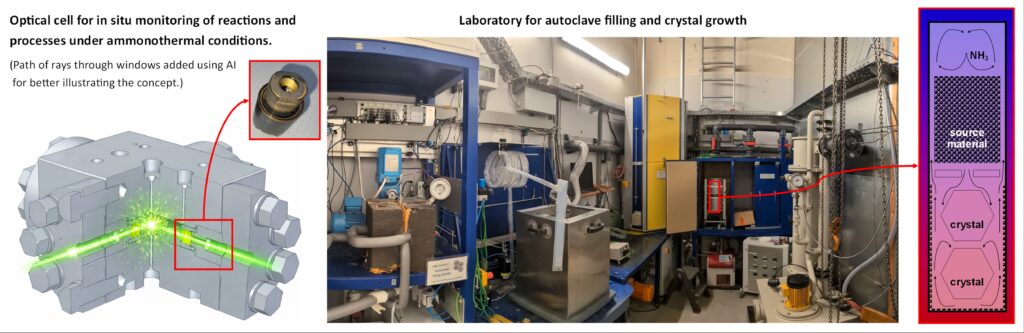
One focus is on the synthesis of nitride materials, including ammonothermal crystal growth, in which supercritical ammonia is used to produce high-quality single crystals and substrate materials. Materials and process engineering approaches to crystal growth and the targeted adjustment of electronic, structural, chemical, and further functional properties are researched, as well as the necessary technological and methodological developments, which are of great importance due to the challenging conditions of the ammonothermal process.
A methodically central aspect is therefore the development and use of advanced high pressure technologies, including X-ray-based and optical in-situ measurement methods, which enable direct, quantitative observation of solution, transport, and crystallization processes under process conditions. Through the combination of material synthesis, in situ monitoring, and process analysis, the underlying chemical-physical mechanisms are systematically elucidated, the reproducibility of experimental processes is improved, and the development of new material systems that can be integrated with established III-nitride technologies is advanced.
Current research topics:
- Ammonothermal crystal growth of binary and ternary III-nitrides – control of conductivity and stoichiometry (Thomas Wostatek)
- Fundamentals of ammonothermal growth of nitride crystals – dissolution, transport, and crystallization (Rajesh Chirala)
- Tuning piezo- and ferroelectric properties of III-nitrides by alloying with metal nitrides – crystallization from N2- and NH3-based solutions and gas phases guided by atomistic sim-ulations (project PiezoTUNE within the priority program Nitrides4Future, currently being developed)
These topics are also the main research areas of the Nitride Semiconductors Working Group headed by Dr. Saskia Schimmel.
Contact
Dr.-Ing. Saskia Schimmel
Research associates