
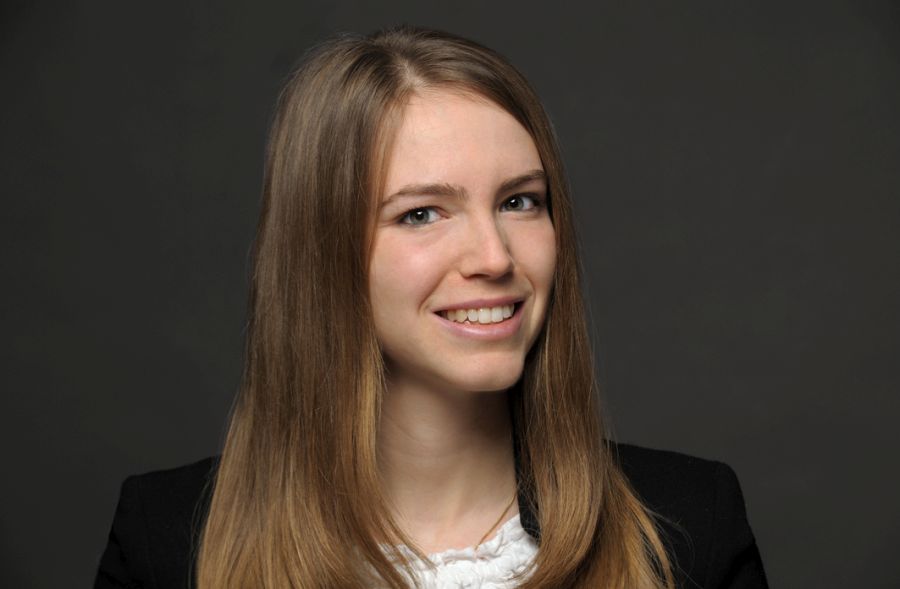
Dr.-Ing. Julietta Förthner
Chair of Electron Devices
Research associates
Address
Contact
2020
- , , , , :
RESURF n-LDMOS Transistor for Advanced Integrated Circuits in 4H-SiC
In: IEEE Transactions on Electron Devices 67 (2020), p. 3278-3284
ISSN: 0018-9383
DOI: 10.1109/TED.2020.3002730
2019
- , , , , , , :
Deeper insight into lifetime-engineering in 4H-SiC by ion implantation
In: Journal of Applied Physics 126 (2019), Article No.: 045701
ISSN: 0021-8979
DOI: 10.1063/1.5092429 - , , , , :
Aluminum acceptor activation and charge compensation in implanted p-type 4H-SiC
In: AIP Advances 9 (2019), p. 055308
ISSN: 2158-3226
DOI: 10.1063/1.5096440
2018
- , , , , , , , , :
Analysis of Compensation Effects in Aluminum-Implanted 4H-SiC Devices
In: Materials Science Forum 924 (2018), p. 184-187
ISSN: 0255-5476
DOI: 10.4028/www.scientific.net/MSF.924.184
2016
- , , , , :
On the origin of threshold voltage instability under operating conditions of 4H-SiC n-channel MOSFETs
In: Materials Science Forum 858 (2016)
ISSN: 0255-5476
DOI: 10.4028/www.scientific.net/MSF.858.473
2016
- , , , , , :
Quantitative Investigation of Near Interface Traps in 4H-SiC MOSFETs via Drain Current Deep Level Transient Spectroscopy
In: Materials Science Forum, 2016
DOI: 10.4028/www.scientific.net/MSF.897.111
2019
- , , , , , , :
Determination of compensation ratios of al-implanted 4H-SIC by tcad modelling of TLM measurements
12th European Conference on Silicon Carbide and Related Materials, ECSCRM 2018 (Birmingham, 2. September 2018 - 6. September 2018)
In: Peter M. Gammon, Vishal A. Shah, Richard A. McMahon, Michael R. Jennings, Oliver Vavasour, Philip A. Mawby, Faye Padfield (ed.): Materials Science Forum 2019
DOI: 10.4028/www.scientific.net/MSF.963.445 - , , , , , , , :
On the origin of charge compensation in aluminum-implanted n-type 4H-SiC by analysis of hall effect measurements
12th European Conference on Silicon Carbide and Related Materials, ECSCRM 2018 (Birmingham, 2. September 2018 - 6. September 2018)
In: Peter M. Gammon, Vishal A. Shah, Richard A. McMahon, Michael R. Jennings, Oliver Vavasour, Philip A. Mawby, Faye Padfield (ed.): Materials Science Forum 2019
DOI: 10.4028/www.scientific.net/MSF.963.433 - , , , :
Design of a 4H-SIC resurf N-LDMOS transistor for high voltage integrated circuits
12th European Conference on Silicon Carbide and Related Materials, ECSCRM 2018 (Birmingham, 2. September 2018 - 6. September 2018)
In: Peter M. Gammon, Vishal A. Shah, Richard A. McMahon, Michael R. Jennings, Oliver Vavasour, Philip A. Mawby, Faye Padfield (ed.): Materials Science Forum 2019
DOI: 10.4028/www.scientific.net/MSF.963.629
- : STAEDTLER-Promotionspreis (STAEDTLER-Stiftung) – 2021
-
Siliziumkarbid-Qubits hin zu einer fabrikreifen Technologie
(Third Party Funds Group – Sub project)
Overall project: QuantERA II ERA-NET
Project leader:
Term: 1. August 2024 - 31. July 2027
Acronym: SiqurTech-QuantERA
Funding source: Deutsche Forschungsgemeinschaft (DFG)The SiCqurTech project aims at developing a radically newapproach towards solid state quantum technology engineering.
SiCqurTech focuses on vacancy-related colour centres in theindustry’s leading 3rd generation semiconductor – silicon carbide – to overcomeone of today’s main challenges in quantum technology: the lack of fab-ready and CMOS-inspired quantum devicefabrication techniques.
SiCqurTech will integrate colour centres in silicon carbidephotonic chips and benchmark their performance for application in quantumcommunication networks. In order to make this technology viable formarket-uptake, we focus quantum-grade fabrication techniques that provide aclear pathway for cost-effective scaling towards 100s to 1000s of devices inthe future.
To this end, SiCqurTech brings together an interdisciplinaryEuropean consortium that will: (1) explore the growth of novel quantum-gradesilicon-carbide material with controlled isotopic concentrations; (2) develop afab-compatible silicon-carbide-on-insulator technology and electrical controlstructures via high-throughput sample characterisation; (3) investigateindustry-compatible surface modification techniques to further improve thespin-optical coherence of colour centres; (4) demonstrate multi-qubit-controland photon mediated entanglement.
SiCqurTech’s results will create a comprehensive fundamentaland practical understanding of the potential of the colour centres insilicon-carbide. This next-generation quantum technology has the potential forestablishing an all-European supply chain.
-
Charge compensation in 4H silicon carbide - Simulation, modelling and experimental verification
(Third Party Funds Single)
Project leader:
Term: 1. April 2016 - 14. April 2019
Funding source: DFG-Einzelförderung / Sachbeihilfe (EIN-SBH)For power semiconductor devices in silicon, device patterns with charge compensation between adjacent p- and n-doped semiconductor regions are applied. These patterns enable the realization of unipolar devices with blocking voltage under blocking operation and low device resistance in forward conduction. First semiconductor devices fabricated in silicon carbide employing charge compensation patterns are following design rules that are either based on theoretical calculations which are based on the well-controlled silicon technology or using non-empiric trial-and-error methods. Hereby, a suitable design of the compensation patterns is achieved either with a poor degree of compensation at all or only by repetitive process variations.This proposal is aiming to provide the foundation for the realization of charge compensation patterns with a high degree of compensation, and to conduct a systematic investigation regarding their electrical characteristics and the impact of physical effects. In particular, the impact of incomplete activation and ionization of dopants in SiC as well as the surface passivation on the degree of compensation, the breakdown voltage and the drift resistance is investigated. This allows for an improvement of existing simulation models for higher accuracy and the derivation of an analytical description of these charge compensation patterns that are not (as in silicon) based on a fully controlled semiconductor technology.With the aid of analytical modelling based on charge compensation patterns in silicon as a starting point and considering incomplete activation of dopants, both modelling and two dimensional TCAD simulations for lateral charge compensation patterns in silicon carbide will be implemented. The fabrication of lateral test patterns corresponding to the simulations and their electric characterization are used to increase the modelling accuracy and extension of the underlying models based on the measurement results. These models are then used to transfer and verify the results to lateral power transistors in SiC. Additionally, dynamic switching experiments will be carried out to evaluate the impact of physical effects like incomplete ionisation on electrical properties (e.g. avalanche breakdown) in charge compensation patterns. Finally, vertical charge compensation patterns will be realized to validate the methodology of this scientific approach as a whole.The results from this research project will simplify the fabrication of lateral and vertical power semiconductor devices on 4H-SiC by provision of accurate physical models for charge compensation.