
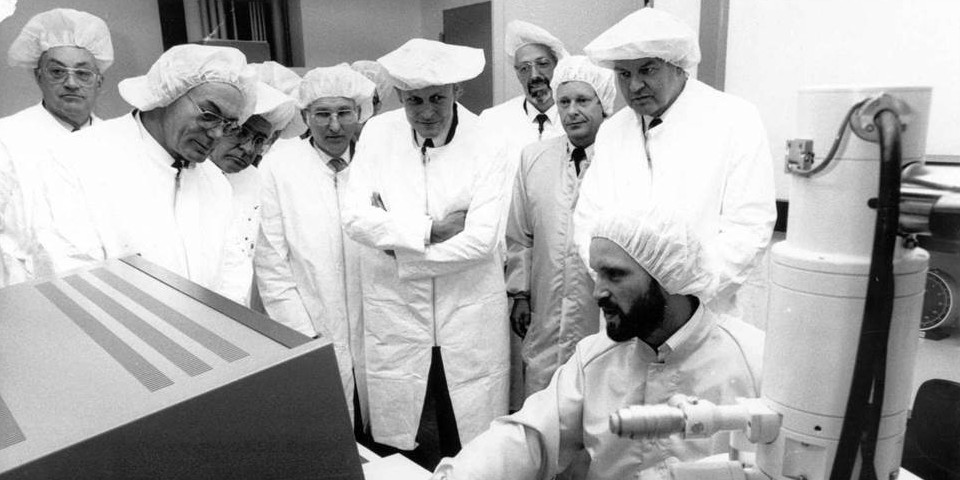
The Chair of Electron Devices was founded in 1985. The chair was initially set up in the converted rooms of an old metalworking shop before the foundation stone for the new LEB institute building and the LEB clean room laboratory was laid in 1990. The clean room laboratory was inaugurated on May 15, 1992, followed by the inauguration of the LEB institute building in 1993.
Personnel
Dr.-Ing. Heiner Ryssel was appointed as the first chair holder in March 1985. In July of the same year, Prof. Ryssel also took on the additional role of head of the Fraunhofer Working Group for Integrated Circuits – Device Technology Division, which became the independent Fraunhofer Institute for Integrated Systems and Device Technology IISB in 2003.
In 1999, Prof. Dr. phil. nat. Michael Stoisiek was appointed to the professorship for Electronic Devices, which he held until his retirement in 2011.
Prof. Dr. rer. nat. Lothar Frey was appointed as Prof. Ryssel’s successor in 2008. Together with Prof. Ryssel, he initially took over both the chair of Electronic Devices and the management of the IISB before Prof. Heiner Ryssel retired in 2009. Until 2018, Prof. Lothar Frey was in charge of the chair and the IISB. In June 2018, Prof. Frey passed away suddenly and unexpectedly. Prof. Dr.-Ing. Martin März was appointed acting head of the LEB in July 2018.
In September 2021, Prof. Dr.-Ing. habil. Jörg Schulze will take over as chair of the LEB.
Research
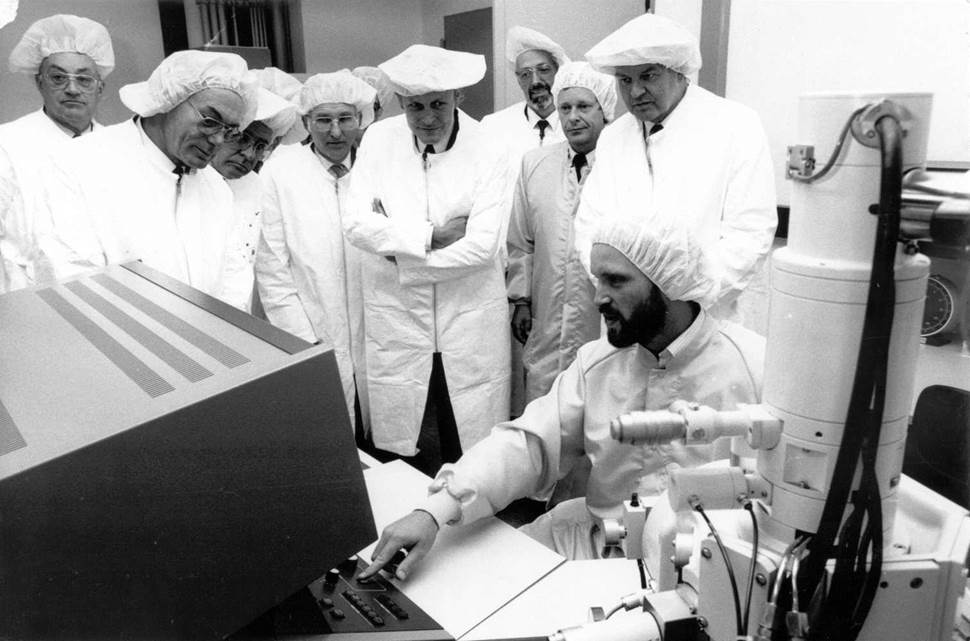
The Chair of Electronic Devices conducts research in the fields of simulation of microelectronic manufacturing steps, semiconductor manufacturing equipment and materials, and semiconductor process technology and analytics.
From the outset, the work has been carried out in close cooperation with the Fraunhofer Working Group AIS-B (later Fraunhofer Institute IISB).
The new technology hall offers the opportunity to expand the process engineering equipment and install a continuous process chain for 150 mm semiconductor wafers for the manufacture of transistors and test structures. An industrial CMOS process is established in 1995/96 as the basis for research and development work in the clean room laboratory. The chair’s research initially focused on the development, characterization, and simulation of individual process steps and materials for silicon technology, including implantation, activation, and diffusion of dopants, as well as the deposition of oxides with high dielectric constants and metallic gate electrodes.
In addition to the development of silicon power devices, initial research work on the manufacture of devices based on silicon carbide (SiC) was carried out in the following years. Furthermore, work on the development of printable electronics established another research focus at the chair.