µe-bauhaus erlangen-nürnberg – Engineering in Teaching & Research
“Young people, come to the Bauhaus!“
Hannes Meyer, from the brochure “bauhaus / junge Menschen kommt ans bauhaus!”, 1929
In 2019, the 100th year after the founding of the famous State Bauhaus in Weimar, which, with its visionary teaching and training concept, initiated a new beginning for architecture, building culture and design and continues to have an impact today, unleashing creative forces worldwide, I – then still at the Institute for Semiconductor Technology (IHT) of the University of Stuttgart – made it my task to adapt this special teaching, training and research concept to the needs of modern microelectronics in order to shape the underlying university engineering education of the 21st century.
With the Bauhaus concept, I want to explore new progressive paths in research-based teaching and practice-oriented training with my students, so that in the future “Bauhaus” will not only be a synonym for architecture, art and design, but also a synonym for progressive engineering in semiconductor-based electrical engineering.
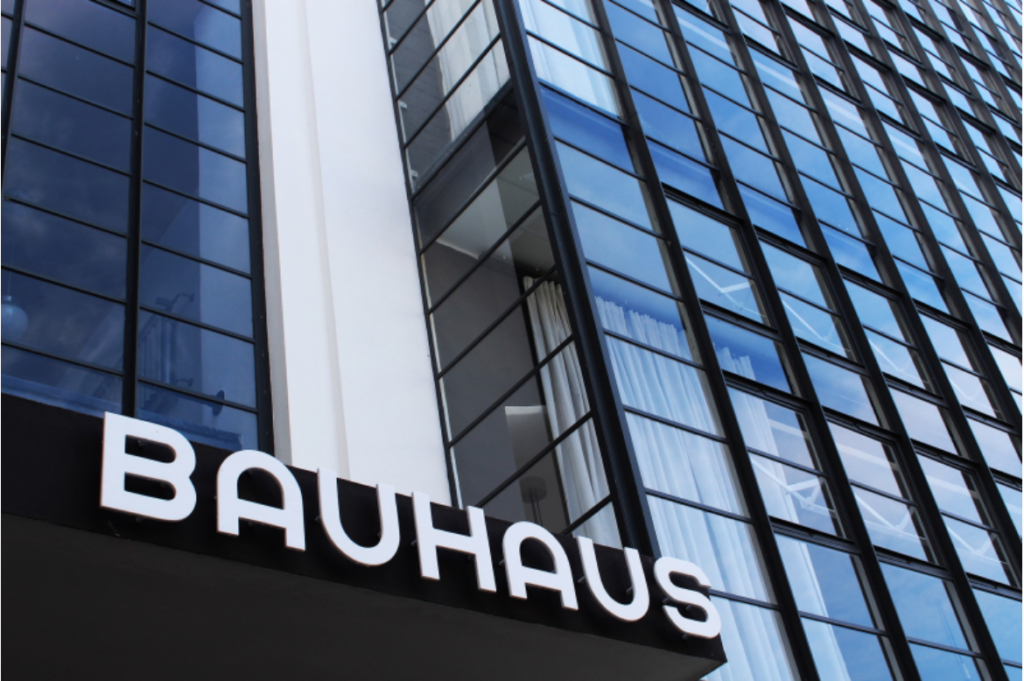
Entrance facade of the Bauhaus Dessau | Photo: Birgit Böllinger, Pixabay, Shutterstock
At an IHT meeting in July 2019, my team and I decided to take the first steps to put the idea of a “Bauhaus of Microelectronics” into practice. This idea has now traveled with me and some of my students to Erlangen and has matured to the point where I was able to found

at the Chair of Electronic Devices (LEB) at our university. It consolidates the chair’s outstanding technical and infrastructural resources, integrates the research-based teaching concept more comprehensively, and significantly expands it. In particular, through the adaptation of the Bauhaus workshop concept, it creates a theoretically sound and highly practice-oriented education. From the first semester of a Bachelor’s or Master’s program, or the first year of an apprenticeship, this teaching concept enables our students and trainees to learn and work independently, creatively, and innovatively in teams.
This is further enhanced by the excellent opportunities offered by the partnership with the associated Fraunhofer Institute for Integrated Systems and Device Technology (IISB).
Our guiding principle is to empower young people to create disruptive innovations, to respond appropriately to disruptive changes, and to be able to embrace and develop these innovations further. The education at the µe-bauhaus erlangen-nürnberg therefore aims to enable our students to make a significant contribution to the people of our country, our society, and our world.
“Electric light was not invented by further developing candles.”
Aphorismus (unknown author )

Foto: minka2507, Pixabay, Shutterstock
Disruption requires not only creative energy, which is linked to a sound knowledge of natural sciences and technology, but also responsibility and ethical conduct.
The µe-bauhaus erlangen-nürnberg therefore sees it as one of its central tasks to live these values, above all by constantly and critically examining the ethics and responsibility of the joint work in teaching and research.

Values, responsibility, ethos – sustainability is an important factor in modern engineering. | Foto: Shutterstock
Furthermore, the µe-bauhaus erlangen-nürnberg sees itself as an interdisciplinary school of knowledge acquisition that sharpens the focus on art & culture and society & politics and contributes to the cosmopolitanism and entrepreneurial spirit of its students.

Daniel Noll, M.Sc., a former student of the Institute for Semiconductor Technology (IHT) at the University of Stuttgart, spent the winter as an electrical engineer at the Neumayer Station III of the Alfred Wegener Institute in Antarctica. | Foto: Daniel Noll
So,
“Young people, come to the Bauhaus!“
based on Hannes Meyer´s text from the brochure “bauhaus / junge Menschen kommt ans bauhaus!”, 1929
Best regards, Jörg Schulze